

On this page:
- A. Covenant Loyalty
- B. Keeping His Commandments
- C. Rejecting Idolatry
- D. Walking in His Ways
- E. A Matter of the Heart
- F. Covenant Blessing
- G. Summarized
The Greatest Commandment: You shall love the LORD your God with all your heart, with all your soul, and with all your strength.” Deuteronomy 6:4. But what does that mean?
To answer the question from the perspective of the Bible, we must allow the Hebrew Scriptures themselves to define the phrase. In English, “love” is often understood primarily as emotion or affection. In the Hebrew Bible, however, the concept of loving God is far more covenantal, relational, and obedient. The Hebrew word most often used is אָהַב (’ahav), which includes affection, loyalty, and faithful commitment within a covenant relationship.
When the Tanakh asks, “What does it mean to love the LORD?”, it consistently answers in three overlapping ways: exclusive loyalty, obedience to His commandments, and wholehearted devotion.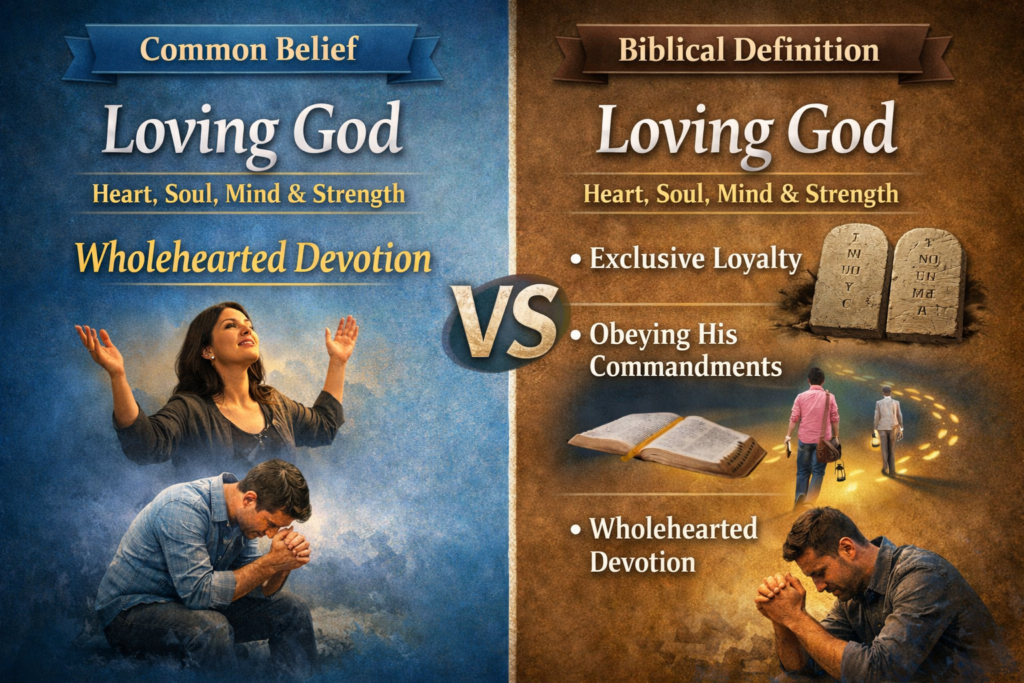
Loving God Means Covenant Loyalty
The foundational text appears in the Book of Deuteronomy 6:4–5, the famous Shema:
“Hear, O Israel: The LORD our God, the LORD is one.
You shall love the LORD your God with all your heart, with all your soul, and with all your strength.”
In the ancient covenant context, love was not merely sentiment; it described faithful allegiance to the covenant king. Similar language appears in ancient Near Eastern treaties, where subjects were commanded to “love” their king, meaning remain loyal and faithful to him.
Thus, loving God in the Bible means total covenant loyalty.
Jesus speaks the same way to the churches in Revelation. He does not measure them by sentiment alone, but by whether they remain faithful to Him.
In Revelation 2:4–5, He warns Ephesus:
“Nevertheless I have this against you, that you have left your first love. Remember therefore from where you have fallen; repent and do the first works…”
Love is not mere profession; it must remain steadfast and active.
Likewise, in Revelation 2:13, Jesus praises Pergamos:
“I know your works, and where you dwell, where Satan’s throne is. And you hold fast to My name, and did not deny My faith…”
This shows covenant loyalty under pressure: holding fast to Him and not denying His name.
Loving God Means Keeping His Commandments
The Bible repeatedly defines love for God as obedience to His commands.
Later in the same book, Moses explains what love looks like in practice:
Deuteronomy 11:1
“Therefore you shall love the LORD your God and keep His charge, His statutes, His judgments, and His commandments always.”
Another explicit statement appears in Deuteronomy 10:12–13:
“And now, Israel, what does the LORD your God require of you, but to fear the LORD your God, to walk in all His ways, to love Him, to serve the LORD your God with all your heart and with all your soul, and to keep the commandments of the LORD…”
Notice how the text defines love:
-
Walk in His ways
-
Serve Him
-
Keep His commandments
Love is therefore expressed through obedience.
Jesus says the same to the churches.
In Revelation 2:26, He says:
“And he who overcomes, and keeps My works until the end, to him I will give power over the nations.”
His standard is not passive belief alone, but keeping His works until the end.
In Revelation 3:8, He commends Philadelphia:
“I know your works. See, I have set before you an open door, and no one can shut it; for you have a little strength, have kept My word, and have not denied My name.”
This adds perseverance: obedience must continue even in weakness.
Loving God Means Rejecting Idolatry
The Bible also frames love for God as the opposite of idolatry.
In Deuteronomy 13:3, Moses warns Israel about false prophets who perform signs but lead people to other gods. The test is explained this way:
“For the LORD your God is testing you to know whether you love the LORD your God with all your heart and with all your soul.”
In this context, love means exclusive loyalty—not turning to other gods or adopting their worship.
This reveals that loving God is fundamentally about faithfulness to Him alone.
Jesus applies the same covenant standard in Revelation by rebuking churches that tolerate compromise.
In Revelation 2:14, He says to Pergamos:
“But I have a few things against you, because you have there those who hold the doctrine of Balaam… to eat things sacrificed to idols, and to commit sexual immorality.”
In Revelation 2:15:
“Thus you also have those who hold the doctrine of the Nicolaitans, which thing I hate.”
In Revelation 2:20, He says to Thyatira:
“Nevertheless I have a few things against you, because you allow that woman Jezebel… to teach and seduce My servants to commit sexual immorality and eat things sacrificed to idols.”
So the churches are tested the same way Israel was tested: will they remain loyal to God, or tolerate spiritual compromise?
Loving God Means Walking in His Ways
Another recurring phrase tied to loving God is “walking in His ways.”
Deuteronomy 30:16 states:
“In that I command you today to love the LORD your God, to walk in His ways, and to keep His commandments…”
Here again the Bible provides its own interpretation: love is demonstrated through living according to God’s revealed instructions.
In Revelation, Jesus adds that this walk must continue through testing and endurance.
He repeatedly says, “to him who overcomes” (Revelation 2:7, 11, 17, 26; 3:5, 12, 21).
This shows that walking in His ways includes enduring faithfully until the end.
Loving God Is a Matter of the Heart
While love includes obedience, the Bible also insists that it must come from the heart, not merely outward ritual.
The prophet Jeremiah anticipates a time when God will transform the hearts of His people.
In Book of Jeremiah 31:33, God says:
“I will put My law within them, and I will write it on their hearts.”
This passage reflects a deeper truth already present in the Torah: loving God involves internal devotion, not just external compliance.
Similarly, Joshua challenges Israel:
In Book of Joshua 22:5:
“Take careful heed… to love the LORD your God, to walk in all His ways, to keep His commandments, to hold fast to Him, and to serve Him with all your heart and with all your soul.”
Love includes attachment, devotion, and loyalty of the inner life.
Jesus says something similar to the churches: He judges not merely outward appearance, but inward reality, and calls for repentance where devotion has grown cold.
In Revelation 2:4–5, He says:
“Nevertheless I have this against you, that you have left your first love. Remember therefore from where you have fallen; repent and do the first works…”
In Revelation 3:1–2, He tells Sardis:
“I know your works, that you have a name that you are alive, but you are dead. Be watchful, and strengthen the things which remain…”
In Revelation 3:19, He says:
“As many as I love, I rebuke and chasten. Therefore be zealous and repent.”
So love must not only be outwardly visible; it must be inwardly real, watchful, and repentant.
Loving God Brings Covenant Blessing
The Bible frequently associates love for God with the covenant blessings promised to Israel.
Deuteronomy 7:9 declares:
“Know therefore that the LORD your God… keeps covenant and mercy for a thousand generations with those who love Him and keep His commandments.”
Again the two ideas are inseparable: love and obedience.
Jesus likewise attaches promises to covenant faithfulness in Revelation.
To each church, He gives promises to the one who overcomes:
-
Revelation 2:7 — access to the tree of life
-
Revelation 2:11 — not hurt by the second death
-
Revelation 2:17 — hidden manna and a white stone
-
Revelation 3:5 — clothed in white garments
-
Revelation 3:12 — made a pillar in the temple of God
-
Revelation 3:21 — granted to sit with Him on His throne
So Revelation adds this emphasis: covenant love must persevere, and those who remain faithful inherit the promises.
The Bible’s Definition Summarized
If we gather the testimony of the Hebrew Scriptures, loving the LORD involves several interconnected realities:
-
Wholehearted devotion — loving Him with heart, soul, and strength
-
Covenant loyalty — remaining faithful to Him alone
-
Obedience to His commandments — living according to His instructions
-
Walking in His ways — aligning one’s life with His character
-
Inner commitment — devotion flowing from the heart
In Revelation 2–3, Jesus speaks with these same covenant categories and adds further emphasis on:
-
Perseverance — overcoming to the end
-
Repentance — returning when love has cooled or compromise has entered
-
Discernment — refusing false teaching and idolatrous compromise
-
Public faithfulness — not denying His name under pressure
In other words, within the worldview of the Bible, love for God is not primarily emotional language. It is covenant faithfulness expressed through obedience and wholehearted devotion to the LORD who redeemed His people.
The Scriptures therefore present love for God as the organizing principle of the covenant life: when Israel truly loves the LORD, they naturally walk in His ways. Jesus applies that same standard to the churches: remain loyal, keep His works, reject compromise, repent when drifting, and overcome to the end.
- Deuteronomy 6:4–5— Exclusive allegiance to the one true LORD.
-
Deuteronomy 11:1— Obedience to God’s commands continually.
-
Deuteronomy 10:12–13— Fear God, walk His ways, serve Him.
-
Deuteronomy 13:3— Loyalty to God over other gods.
-
Deuteronomy 30:16— Walk His ways and keep commandments.
-
Jeremiah 31:33— God’s law written on the heart.
-
Joshua 22:5— Hold fast to Him; serve wholeheartedly.
-
Deuteronomy 7:9— Covenant mercy for faithful obedience.
-
Revelation 2:4–5— Return to your first love.
-
Revelation 2:13— Hold fast His name under pressure.
-
Revelation 2:14–15— Reject doctrinal and idolatrous compromise.
-
Revelation 2:20— Do not tolerate corrupting influence.
-
Revelation 2:26— Keep His works until the end.
-
Revelation 3:1–2— Outward reputation is not enough.
-
Revelation 3:8— Keep His word despite weakness.
-
Revelation 3:19— Zealous repentance proves real love.