

On this page
- A. Introduction
- B. How Jesus Defines True Discipleship
- C. The Apostolic Pattern Does Not Support Prosperity
- D. The Covenant Dilemma Created by the Prosperity Gospel
- E. Are “Blessings” Only for Israel—or Have We Misdefined Them?
- F. Misunderstanding “Redemption from the Curse”
- G. When Faith Becomes a Method Instead of Trust
- H. Scripture Warns About This Mindset
- I. The Example of Christ Himself
- J. Final Thought
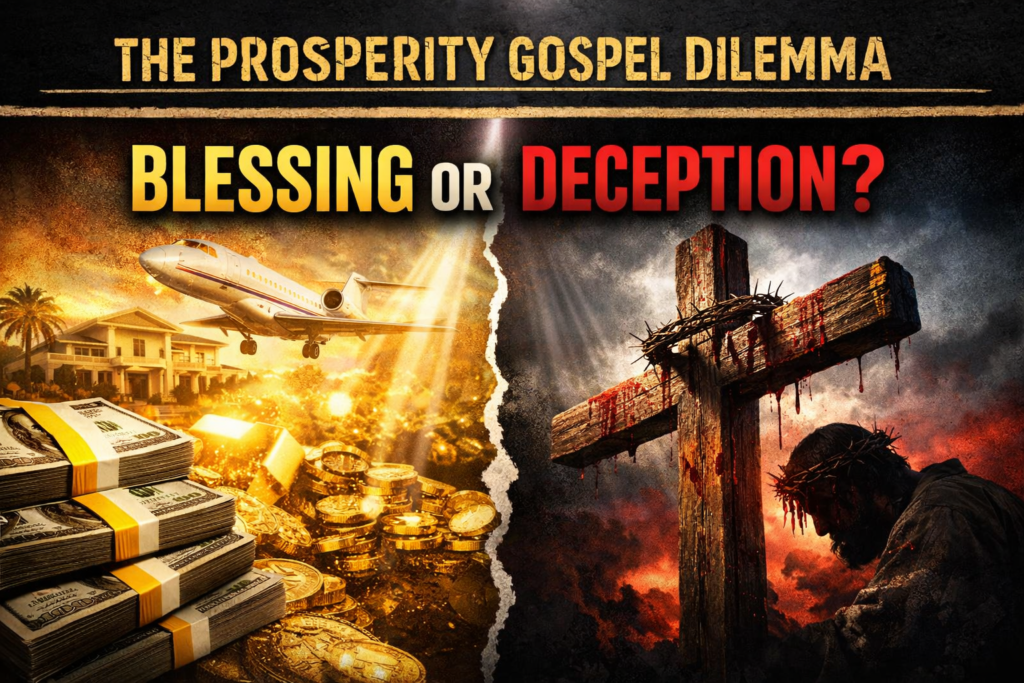
The idea that strong faith leads to visible prosperity has become widely accepted in modern Christianity—but it raises a critical question: is this what Scripture actually teaches? Many appeals to “blessing” draw from covenant language and Old Testament promises, yet when examined in context, those promises are often misapplied or misunderstood.
When we turn to the words of Jesus and the testimony of the apostles, we encounter a very different pattern—one that includes sacrifice, suffering, and endurance alongside God’s provision and care. This creates a necessary tension: is the Christian life defined by outward abundance, or by faithful obedience to Christ regardless of circumstance?
The central question is not whether God blesses His people. The question is whether Scripture teaches that material abundance is the defining proof of true faith.
To answer that, we have to return to Scripture and carefully examine what God has truly promised.
1. How Jesus Defines True Discipleship
One of the clearest tensions with the prosperity message is how it defines what it means to follow Christ.
Jesus does not frame discipleship in terms of increase, but surrender.
- Luke 9:23 — “If anyone would come after Me, let him deny himself and take up his cross daily and follow Me.”
- Luke 14:33 — “So therefore, any one of you who does not renounce all that he has cannot be My disciple.”
That is not a pathway to accumulation, but to self-denial.
Jesus also gives a clear test of what marks a true disciple:
- John 8:31 — “If you abide in My word, you are truly My disciples.”
Not wealth. Not outward success. Not visible abundance. Jesus says the mark of a disciple is abiding in His word.
So right from the beginning, the prosperity message collides with Christ’s own definition of discipleship.
2. The Apostolic Pattern Does Not Support Prosperity
If material abundance were the norm for strong faith, we would expect to see it in the apostles.
Instead, we see the opposite.
- 1 Corinthians 4:11 — hunger, hardship, instability
- Philippians 1:29 — suffering is “granted” to believers
- 2 Corinthians 12:9 — weakness becomes the place where Christ’s power is displayed
This makes it very difficult to argue that hardship reflects weak faith. Scripture presents suffering, weakness, and endurance as part of faithful Christian living.
If the apostles are our pattern of faithful Christianity, then the prosperity model does not fit the apostolic witness.
That does not mean God never provides, heals, or blesses in tangible ways. It means those things are not the defining measure of spiritual maturity.
3. The Covenant Dilemma Created by the Prosperity Gospel
A lot of prosperity teaching depends on taking passages like Deuteronomy 28 and applying them directly to Christians today, as though the covenant promises given to Israel in the land function as universal guarantees for all believers under the New Covenant.
But those promises were:
- Given to Israel as a nation
- Tied to a specific land
- Part of the Mosaic covenant structure
The blessings in Deuteronomy 28 involve things like crops, land, livestock, fertility, military safety, and national prominence. Those are covenant-specific realities, not timeless blank checks for every believer in every era.
This is where the prosperity gospel flattens the covenants. It treats redemptive history like one straight line, instead of a story with covenant movement, fulfillment, and transformation.
Under the New Covenant, blessing is reframed:
- Galatians 3:14 — the blessing of Abraham comes through the promised Spirit
- Ephesians 1:3 — believers are blessed with every spiritual blessing in Christ
This is a shift from external prosperity to internal, eternal, Christ-centered realities.
4. Are “Blessings” Only for Israel—or Have We Misdefined Them?
Deuteronomy 28:1-14 raises an important question often used to defend prosperity teaching:
“Are the blessings of Deuteronomy only for Israel?”
The answer is not as simple as “yes” or “no.”
No—God’s heart to bless is not limited to Israel alone. But also no—these covenant promises cannot be lifted out of their context and applied mechanically to every believer as guaranteed material outcomes.
The real issue is not whether God blesses His people. The real issue is how Scripture defines blessing—and whether we have replaced that definition with our own.
Argument 1: Covenant Blessing Is Not a Mechanical Entitlement
Prosperity teaching often assumes that blessing works like a system:
- Obey → receive material increase
- Disobey → experience lack
But this reduces covenant into something like a formula or transaction.
What if blessing and cursing function less like a reward system… and more like the natural consequences of living within or outside of God’s design?
For example:
- If someone jumps off a cliff, what happens?
- Is that “judgment”… or the law of gravity at work?
In the same way, living outside of God’s ways produces real consequences—not because God is mechanically tallying outcomes, but because His ways align with life itself.
Disobedience leads to destruction not merely by decree, but by design.
Argument 2: Wealth Is Not Proof of Blessing
One of the biggest assumptions in prosperity thinking is this:
External success = God’s blessing
But this falls apart when examined honestly.
Consider the realities often seen among the wealthy:
- High rates of depression and suicide
- Broken families and divorce
- Children growing up without direction or stability
Is that blessing?
Scripture never defines blessing as simply having more. In fact, it repeatedly warns that wealth can exist alongside spiritual emptiness.
Material abundance can coexist with spiritual poverty.
So the presence of wealth proves nothing about someone’s standing before God.
Argument 3: We Often Misidentify What Blessing Actually Is
What if the issue is not that God isn’t blessing—but that we are defining blessing incorrectly?
Consider a different picture of blessing:
- Having enough to meet your needs
- Food on the table
- Peace in your home
- A stable and faithful family
- A clear conscience before God
What if “daily bread” is actually the blessing… not excess?
Scripture consistently points toward contentment, peace, and relationship with God as true forms of blessing—not accumulation.
That means blessing is often:
- Spiritual, not material
- Internal, not external
- Relational, not transactional
Argument 4: Many Blessings Are Only Seen in Hindsight
Another flaw in prosperity thinking is the assumption that blessing should be obvious in the moment.
But in reality, how often do we recognize blessing after the fact?
“I’m so glad God didn’t give me what I wanted.”
How many times has that been true?
There are moments when what feels like lack or delay is actually:
- Protection
- Redirection
- Prevention from something harmful
Not all “no’s” from God are curses. Many are mercies.
But if we define blessing only by what we receive in the moment, we will miss what God is actually doing.
Final Point: The Real Error
The deeper issue is not just misreading a passage—it is misdirecting the heart.
Prosperity thinking trains people to seek God’s hand instead of His face.
It shifts the focus from:
- God Himself → to what He gives
- Relationship → to results
- Faithfulness → to outcomes
But Scripture calls us to something deeper.
The greatest blessing is not what God gives. The greatest blessing is God Himself.
5. Misunderstanding “Redemption from the Curse”
This is another major issue in prosperity teaching.
The claim is often framed like this:
If Christ redeemed us from the curse, then sickness, lack, and hardship should not remain in the believer’s life.
But Scripture presents a different picture:
- Romans 8:23 — believers still groan while awaiting the redemption of their bodies
- Romans 8:17 — we suffer with Christ before we are glorified with Him
So redemption is real and secure, but it is not yet fully realized in our present bodily experience.
The New Testament does not say that all weakness, sickness, hardship, or loss has already been removed from the Christian life. It says that in Christ, condemnation is removed, reconciliation is secured, and future glory is guaranteed.
The prosperity error is to drag future fullness into the present as though resurrection realities must already appear in complete form now.
God does heal. God does provide. But those mercies are never presented as a covenant machine that proves spiritual status on demand.
6. When Faith Becomes a Method Instead of Trust
Another subtle shift happens in prosperity teaching: faith starts to function like a system.
It can begin to sound like this:
- Say the right things
- Believe strongly enough
- Give correctly
- Refuse all doubt
- Hold your confession long enough
But Scripture presents faith very differently:
- Ephesians 2:8–9 — salvation is rooted in grace, not human performance
When outcomes become tied to how well someone “applies” faith, the focus begins to move away from Christ and toward human execution.
Faith stops being trust in Christ and starts becoming faith in faith.
That is one reason prosperity teaching becomes pastorally cruel: when the promised outcome does not come, the burden is often pushed back onto the sufferer.
7. Scripture Warns About This Mindset
There are direct warnings in Scripture that sound very close to the prosperity framework:
- 1 Timothy 6:5 — treating godliness as a means of gain
- 1 Timothy 6:9 — the desire to be rich leads to ruin and harm
This does not mean wealth itself is inherently sinful. But it does mean Scripture explicitly warns against using spiritual things as a path to personal gain.
Any system that makes abundance the proof of godliness is walking dangerously close to the very error Scripture warns against.
The danger is not simply greed. The danger is redefining blessing in a way that makes Christ’s value secondary to what He can provide.
8. The Example of Christ Himself
Ultimately, everything must be measured against Jesus.
- Matthew 8:20 — “The Son of Man has nowhere to lay His head.”
- Philippians 2:8 — He humbled Himself and became obedient to the point of death
His life was not marked by material abundance, but by humility, obedience, sacrifice, and the cross.
If material prosperity were the clearest proof of closeness to God, the earthly life of Jesus would be impossible to explain.
Instead, Christ shows us that the path of perfect obedience may include suffering, rejection, and loss—yet still be the path most fully pleasing to the Father.
9. Final Thought
This is where the issue finally lands.
- The gospel is not primarily about improving our external circumstances
- It is about reconciling us to God through Christ
God does provide. He does care. He does bless His people in real and tangible ways. But Scripture never presents:
- Prosperity as the goal
- Abundance as proof of faith
- Lack as evidence of failure
Instead, Scripture points us toward something deeper:
- Knowing God/Yah by Knowing Christ
- Being transformed by Him
- Trusting Him in both abundance and need
The greatest problem with prosperity theology is that it shrinks the gospel. It says much about blessing, but far too little about Christ Himself.
Once that becomes clear, it becomes very difficult to keep calling material abundance the defining mark of true faith. The real abundance of the gospel is not that Christ gives us a better version of the life we would have chosen anyway. The real abundance of the gospel is that in Christ, sinners are reconciled to God, forgiven, adopted, indwelt by the Spirit, and given a kingdom that cannot be shaken.
Christ Himself is the blessing.