

A verse many Christians have never studied
Discussion Points
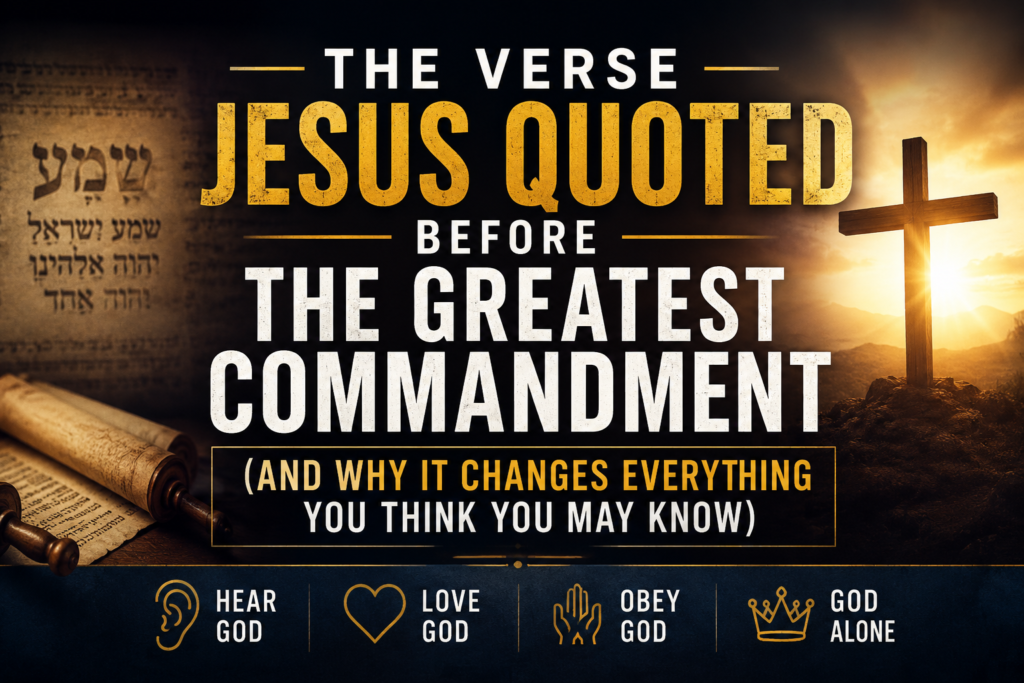
The Verse Jesus Quoted Before the Greatest Commandment
And Why It Changes Everything You Think You May Know
If I asked most Christians, “What is the greatest commandment?” almost everyone would answer:
“Love the Lord your God with all your heart, soul, mind, and strength.”
And that answer is correct.
But have you ever noticed that Jesus framed that commandment by quoting something first?
Before Jesus gave the command to love God, He quoted the Shema:
“Hear, O Israel: The LORD our God, the LORD is one.”
Many Christians have never studied this verse. Many assume it is only “Jewish.” But Jesus did not treat it as irrelevant. He used it as the foundation that frames the greatest commandment.
The point is not that the Shema replaces the commandment to love God. The point is that the Shema explains the foundation underneath it.
Before we can understand what it means to love God, we must first settle who God is.
Discussion Questions
- When you hear “love God,” do you first think of emotion, loyalty, obedience, or worship?
- Have you ever noticed that Jesus quoted the Shema before saying to love God?
- Why would Jesus begin by reminding people who God is?
1. The Question in Mark 12
In Mark 12, a scribe asks Jesus:
“Which is the first commandment of all?” — Mark 12:28
This was not a casual question. He was asking:
“What is the foundation underneath everything God commands?”
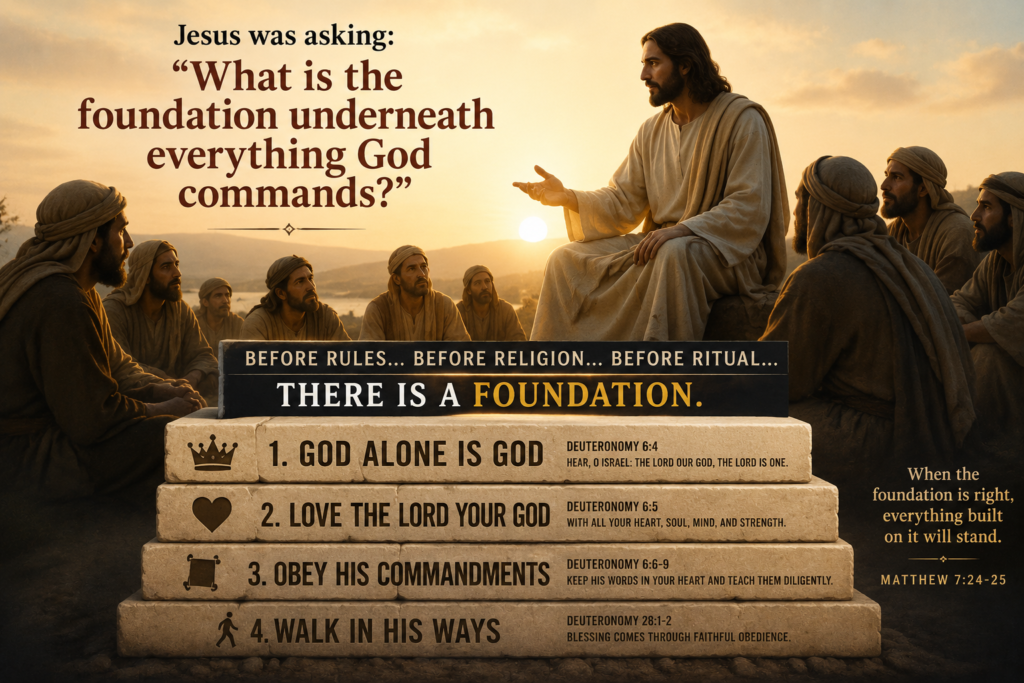
Jesus answered by quoting the Shema first:
“Hear, O Israel, the LORD our God, the LORD is one.” — Mark 12:29
Then He gave the commandment:
“And you shall love the LORD your God with all your heart, with all your soul, with all your mind, and with all your strength.” — Mark 12:30
So we should be careful with our wording. The Shema is not replacing the command to love God. Rather, Jesus uses the Shema as the statement that precedes and frames the commandment.
Jesus was saying: first settle who God is.
Remember where Jesus was standing. He was in Jerusalem, in the Temple environment, where people outwardly claimed:
“We worship YHWH.”
They had the Temple. They had sacrifices. They had Scripture. They had prayers. They had religious vocabulary. They knew the words.
But Jesus had already warned:
“This people honors Me with their lips, but their heart is far from Me.” — Mark 7:6
So when Jesus quotes the Shema, He is pressing the issue deeper:
“You know the words. You recite the words. But do you actually live them?”
The order matters:
- God alone is God.
- Therefore, love Him completely.
- Therefore, obey Him faithfully.
Before love comes allegiance. Before obedience comes surrender.
Then notice the scribe’s response:
“Well said, Teacher. You have spoken the truth, for there is one God, and there is no other but He.” — Mark 12:32
The scribe understood the words. He understood the truth. He even understood that loving God and loving one’s neighbor were greater than burnt offerings and sacrifices.
Then Jesus gave this sobering reply:
“You are not far from the kingdom of God.” — Mark 12:34
Jesus did not say, “You are in the kingdom.” He said, “You are not far.”
That should make us stop and think.
Knowing Scripture and living Scripture are two different things.
Knowing the Shema is not the same as living the Shema.
Knowing the greatest commandment is not the same as loving God with all your heart, soul, mind, and strength.
A person can be close to truth and still need full surrender.
Discussion Questions
- Why did Jesus quote the Shema before giving the command to love God?
- What is the difference between knowing religious words and living them?
- Why is “You are not far from the kingdom of God” both encouraging and sobering?
- Can a person understand the Bible and still not be fully surrendered?
2. The Verse Most Christians Skip
Many Christians quote the command to love God, but skip the verse Jesus quoted right before it.
Why does that matter?
Because the Shema tells us who God is before we are commanded to love Him.
The Shema says:
“Hear, O Israel: The LORD our God, the LORD is one.” — Deuteronomy 6:4
This was not merely a Jewish prayer. This was the foundation of covenant faithfulness.
Jesus did not treat it as outdated. He did not treat it as irrelevant. He did not act as though New Testament believers could ignore it.
He used it to frame the greatest commandment.
If Jesus used the Shema to frame the greatest commandment, Christians should not overlook it.
Discussion Questions
- Why do many Christians know “love the Lord your God” but not the Shema before it?
- What happens when Christians separate Jesus from the Scriptures He quoted?
- How does the Shema help define what loving God actually means?
3. What “Hear” Really Means
The Hebrew word translated “hear” is shema.
It does not mean merely hearing sound with your ears.
In Hebrew thought, to hear means:
- to listen,
- to receive,
- to respond,
- to obey.
So when God says, “Hear, O Israel,” He is not saying:
“Listen to this interesting religious idea.”
He is saying:
“Receive this, respond to this, obey this, and live under this truth.”
In Scripture, hearing God while refusing to obey God is not truly hearing God.
Discussion Questions
- What is the difference between hearing information and hearing in the biblical sense?
- Where have you heard God’s Word but delayed obedience?
- Why is repeated hearing without obedience spiritually dangerous?
4. Is Loving God Just Emotion?
Many Christians today think loving God means:
- I feel close to Jesus.
- I enjoy worship music.
- I cried during prayer.
- I felt goosebumps at church.
Those emotions may be sincere, but biblical love is deeper than emotion.
Jesus said:
“If you love Me, keep My commandments.” — John 14:15
John wrote:
“For this is the love of God, that we keep His commandments. And His commandments are not burdensome.” — 1 John 5:3
Biblical love is not less than affection, but it is much more than affection.
A person may feel emotional during worship and still resist God in daily life.
A person may sing passionately and still refuse obedience.
A person may say “I love God” and still have another master.
Biblical love is covenant loyalty expressed through obedience.
Discussion Questions
- How does our culture usually define love?
- How does Jesus define love in John 14:15?
- Can spiritual emotion be real but still incomplete?
- Where might Christians confuse emotion with obedience?
5. The Shema Was Never Merely “Jewish”
Some Christians think:
“The Shema is Jewish. I am a New Testament Christian.”
But that argument falls apart when we see Jesus Himself quoting it in His answer about the greatest commandment.
Jesus did not say:
“That was for them.”
He used the Shema as the foundation that precedes the command to love God.
The Shema declares:
“The LORD our God, the LORD is one.”
This means more than “there is only one God.” It means:
- YHWH alone is God.
- YHWH alone is King.
- YHWH alone deserves worship.
- YHWH alone has our allegiance.
Ancient Israel was tempted to say:
“YHWH and Baal.”
Modern Christians may be tempted to say:
“Jesus and comfort.”
“Jesus and money.”
“Jesus and self.”
“Jesus and approval.”
The Shema is not merely about belief. It is about exclusive allegiance.
Discussion Questions
- Why might Christians wrongly dismiss the Shema as only “Jewish”?
- What does it mean that Jesus used the Shema in His answer?
- What is the difference between saying “there is one God” and living as if God alone is God?
6. Modern Idols
Ancient Israel was tempted to worship YHWH and Baal.
YHWH and Asherah.
YHWH and the gods of the surrounding nations.
Today, many Christians are tempted to worship Jesus and:
- money,
- comfort,
- success,
- politics,
- entertainment,
- technology,
- approval,
- self.
Jesus warned:
“No one can serve two masters.” — Matthew 6:24
Notice He did not say, “No one can believe in two masters.”
He said, “serve.”
The real question is not only what we claim to believe.
The real question is what we serve, obey, fear, chase, protect, and prioritize.
The issue is not merely what we claim. The issue is what we serve.
Discussion Questions
- Which modern idols are easiest for Christians to excuse?
- How can money, comfort, or entertainment become a master?
- What does your calendar reveal about what you serve?
- What does your anxiety reveal about what you trust?
7. The Warning to the Church
The great danger for Israel was often not rejecting God completely.
The danger was mixing God with other gods.
That same danger faces the modern Church.
We can say:
“Jesus is Lord.”
while living as if comfort is lord.
We can sing worship songs while money controls our decisions.
We can attend church while entertainment owns our mind.
We can speak Christian language while self remains on the throne.
This is why the Shema is such an alarm bell.
It forces us to ask:
“Does God have rivals in my life?”
The Shema confronts divided allegiance.
Discussion Questions
- Why is religious mixture sometimes more dangerous than open unbelief?
- How can a person say “Jesus is Lord” but functionally live under another master?
- What are signs that a believer’s heart is divided?
8. Biblical Love Means Allegiance
In modern culture, love is often treated as a feeling.
But in Scripture, love toward God includes loyalty, faithfulness, obedience, and devotion.
That is why Jesus connects love and obedience:
“If you love Me, keep My commandments.” — John 14:15
And again:
“He who has My commandments and keeps them, it is he who loves Me.” — John 14:21
So when Jesus quotes the Shema before commanding love, He is putting everything in order:
- Hear God.
- Acknowledge God alone.
- Love God completely.
- Obey God faithfully.
Before love comes allegiance.
Before obedience comes surrender.
Before true worship comes the recognition that God alone is God.
Before love comes allegiance. Before obedience comes surrender.
Discussion Questions
- Why must allegiance come before biblical love?
- What happens when Christians try to love God emotionally but refuse obedience practically?
- How does John 14:15 challenge modern ideas of love?
- What command of God do Christians today often treat as optional?
9. The Personal Challenge
If someone watched your life for one year without hearing your words, who would they conclude is your god?
Look at:
- your calendar,
- your spending,
- your worries,
- your habits,
- your entertainment,
- your conversations,
- your obedience,
- your prayer life.
These reveal what truly rules the heart.
The question is not merely:
“Do I believe in God?”
The deeper question is:
“Is the LORD alone my God?”
A person may know Scripture, recite Scripture, defend Scripture, and still not be fully surrendered to the God of Scripture.
That is why Jesus’ words to the scribe are so sobering:
“You are not far from the kingdom of God.”
Not far is not the same as fully surrendered.
Close is not the same as inside.
Understanding is not the same as obedience.
The Shema asks whether God has rivals in our heart.
Discussion Questions
- If someone observed your life, what would they think matters most to you?
- What area of your life most clearly shows allegiance to God?
- What area of your life may reveal divided allegiance?
- What is the difference between being “not far” and being fully surrendered?
Closing Call
Jesus did not merely tell us to love God.
He first reminded us who God is.
“Hear, O Israel: The LORD our God, the LORD is one.”
Only then did He say:
“And you shall love the LORD your God with all your heart, with all your soul, with all your mind, and with all your strength.”
Perhaps many Christians have tried to live the second half while ignoring the first.
Maybe that is why so many feel divided, distracted, lukewarm, and spiritually dry.
The Shema calls us back to the center:
- One God.
- One King.
- One Master.
- One heart.
- No rivals.
Jesus was not merely giving a religious answer.
He was exposing the foundation underneath everything God commands.
First settle who God is.
Then love Him completely.
Then obey Him faithfully.
The greatest commandment does not begin with emotion.
It begins with allegiance.
“Hear, O Israel: The LORD our God, the LORD is one.”
Final Reflection Questions
- Do I merely know the words, or do I live them?
- Is God one part of my life, or is He Lord over all of it?
- Do I define love by emotion, or does Scripture define love for me?
- What rival needs to be removed from my heart?
- Can I honestly say, “The LORD alone is my God”?